

WikiPepper Editorial
Quick Reference
- Most common peppers (annuum) fruit well in a 7–10 gallon final container; superhots (chinense) want 10–15; big aji types (baccatum) 15-plus.
- Watch the label: a nursery “trade gallon” is only 0.75 of a real U.S. gallon, a “#3 pot” holds about 2.25 actual gallons.
- Up-pot in stages rather than jumping straight to the final size, it avoids root shock and overwatering.
Two separate questions hide inside pot sizing: the smallest pot a pepper can survive in, and the pot it actually wants. The gap between them is most of the difference between a stunted plant and a loaded one.
Trade gallons are not gallons
Nursery pots are labeled in trade gallons, an industry standard equal to about 0.75 U.S. gallons (2.84 liters). A pot sold as “3-gallon trade” holds roughly 2.25 real gallons. When a growing guide names a size, check whether it means trade or true volume; liters are the only unambiguous label.
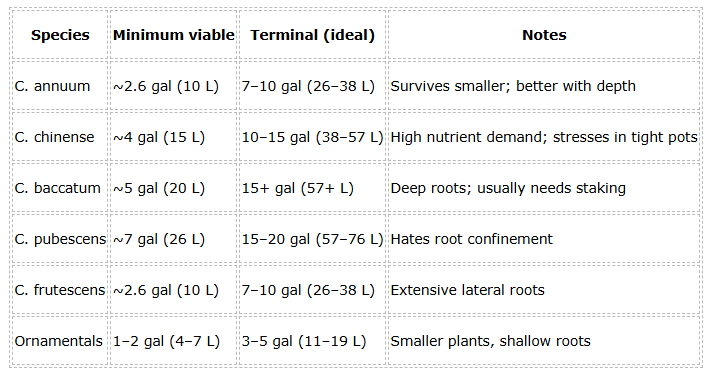
Minimum vs. terminal size by species
Is a 5-gallon bucket enough?
The classic question, and the source of the confusion above: a true 5-gallon bucket holds about 19 liters, real gallons, not trade gallons. That clears the minimum for a common annuum or frutescens pepper (about 10 L) with room to spare, sits right at the minimum for a chinense superhot (about 15 L), and falls below the minimum for a big baccatum (about 20 L). So yes for most peppers, comfortably above survival, below ideal, tight for a habanero or ghost, and undersized for a full-size aji. Drill drainage holes; a bucket has none.
Minimum sizes work for space-saving or short seasons but invite stunting, root-bound stress, and yield loss. Terminal sizes give full root expansion and stress tolerance for a whole season.
Grower’s Takeaway
- Verify actual volume, not the label.
- Depth beats width for the final container.
- Fabric pots punch above their volume, air pruning and drainage.
- Up-pot in stages.
Sources & Further Reading
- Priest, C.T. & Austin, D.J. The Chile Pepper Almanac. Amazon.
- Drawn from the WikiPepper reference library; related coverage at WikiPepper.org on pot sizing, plant spacing, and transplanting.
 Tech Prolite